Treatment Planning
Dentist or endodontist for a root canal: when a general dentist treats vs refers
Start with a dental assessment. Learn when a general dentist can do a root canal, why you might be referred and what to ask before treatment.
27 November 2026
By Dr Beena Kurian, Dentist
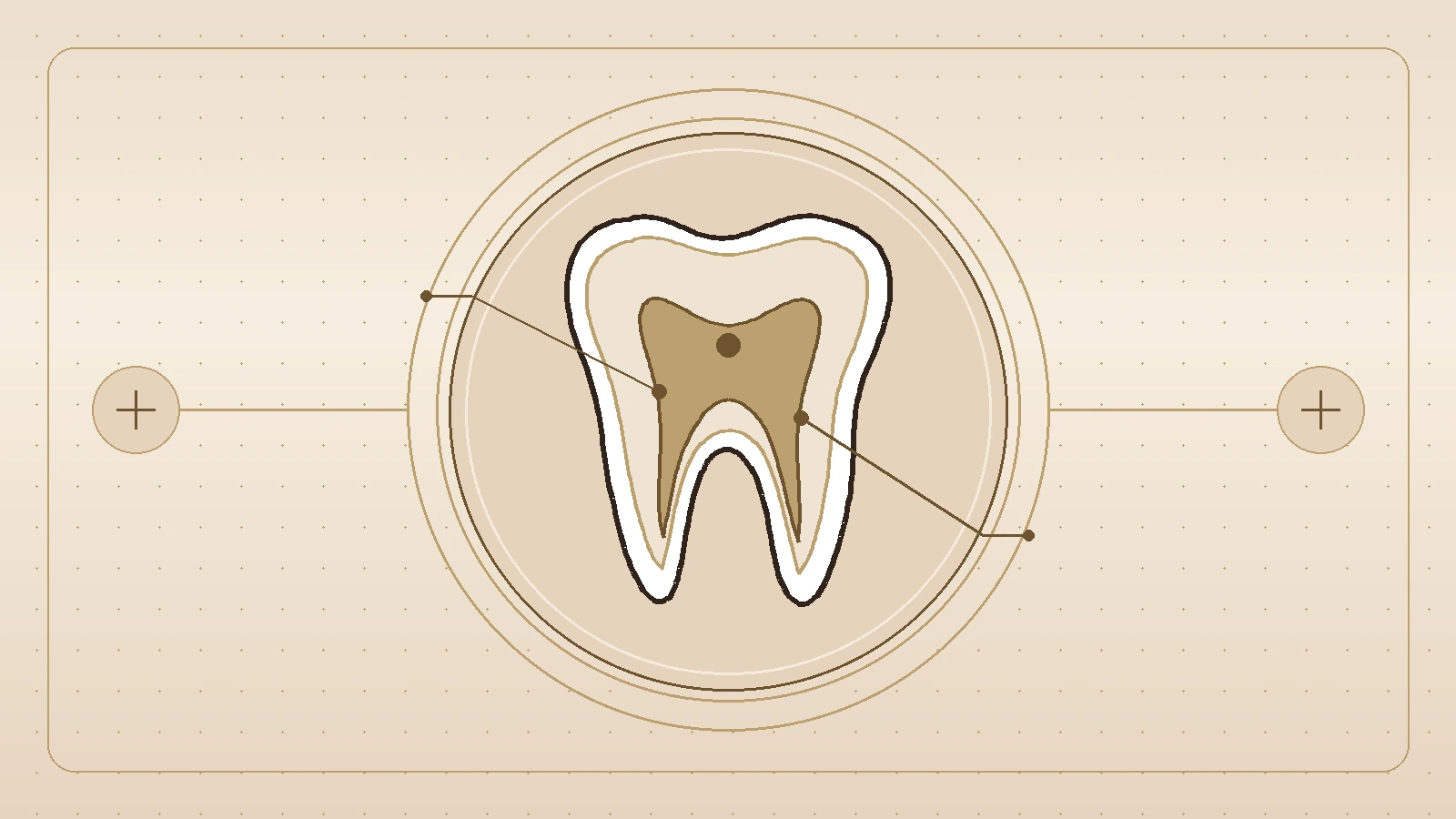
The decision comes down to the source of the problem, whether the tooth can be rebuilt and how difficult the canal work is likely to be. Some referrals are for a second assessment. Others are for a specific part of treatment, with your general dentist completing the final restoration. Read Better Health Channel's guide to root canal treatment.
What your dentist checks first
The pulp is the tissue inside the tooth that contains nerves and blood vessels. It can become inflamed or infected after deep decay, a crack, an injury or repeated dental work. A lingering response to hot or cold, pain when biting, a change in tooth colour or a small bump on the gum can be clues. A loose tooth or a sore gum also needs examination, since several dental problems can produce similar symptoms.
Tell your dentist when the pain started, whether it wakes you, what triggers it and whether the tooth has been treated before. Your dentist may examine the tooth and gums, check how the tooth responds to cold and use X-rays to look at its roots and surrounding bone. If the source is uncertain, ask which findings support the diagnosis and what another assessment might clarify. Read Healthdirect's guide to toothache and gum swelling.
Severe pain or swelling warrants urgent dental assessment, even if you already have a specialist appointment booked. Seek emergency medical care if you have trouble breathing or speaking, or swelling around an eye or the neck.
When a general dentist treats and when they refer
Many straightforward root canals can be treated by a general dentist. The Dental Board of Australia expects practitioners to work within their individual education, training and competence and to refer when care falls outside that scope. Two teeth of the same type can need different plans. Ask what the examination found in your tooth and what would change the decision to treat or refer.
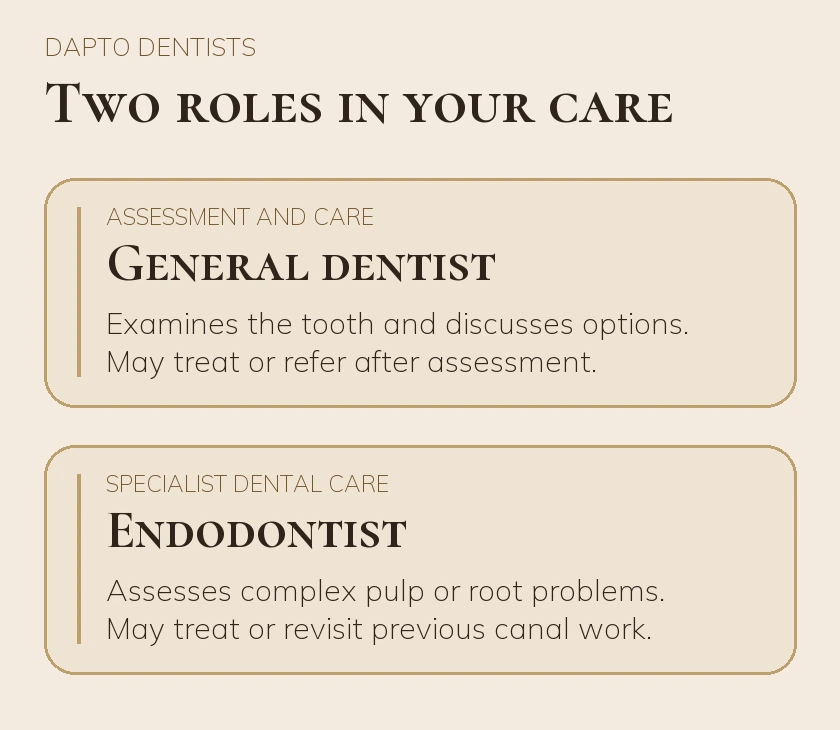
Referral may be discussed if the roots or canals are difficult to assess or access, if the source of pain remains unclear, or if an injured or cracked tooth needs a specialist opinion. A tooth that has already had root canal treatment may also need reassessment if symptoms return or X-rays show signs of disease. A specialist may discuss retreatment or, in selected cases, treatment around the root tip. The assessment can also help determine whether extraction is a reasonable alternative.
A dental X-ray can help your dentist see the area below the gum. In selected complex cases, the clinician may discuss a microscope or a three-dimensional scan to investigate a particular issue with a root or canal. Ask what information the scan could add and whether it would affect the plan. Read the Australian Dental Association's guide to dental X-rays.
From assessment to a treatment or referral plan
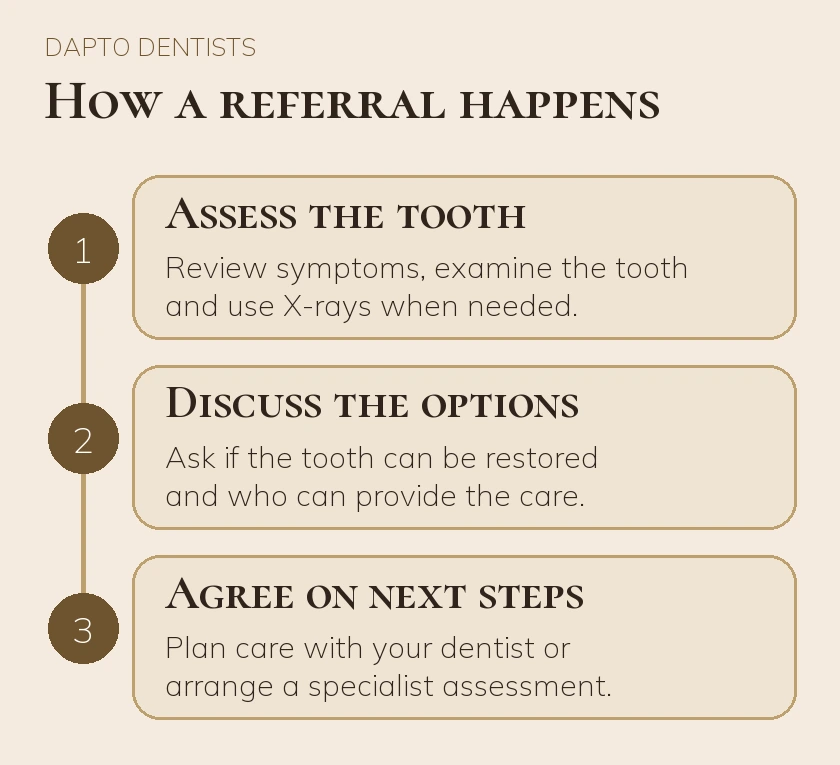
- Ask whether the tooth can be restored. Treating the canals is one part of keeping a tooth. The dentist must also consider how much tooth structure remains and whether a filling or crown can seal and protect it. If the damage is extensive, ask what keeping the tooth would involve and discuss the implications of extraction, including whether you would want to replace the tooth.
- Agree on who will assess or treat the tooth. If your dentist proposes a referral, ask whether it is to confirm a diagnosis, evaluate a previous root canal or carry out treatment. Ask what X-rays, notes or past treatment records can be sent and whether your appointment is for assessment only.
- Ask what should happen while you wait and afterwards. Confirm who to contact if symptoms change. If you proceed with a root canal, ask who will place the final restoration and when to book it. Ask each practice for a written estimate of the parts it will provide, including consultation, any imaging, canal work and the final filling or crown.
What the procedure and recovery can involve
Your dentist or endodontist uses local anaesthetic to numb the area and a rubber dam to isolate the tooth. The clinician opens the tooth to reach the pulp, removes damaged tissue, then cleans, shapes and disinfects the canals. The canals are filled and sealed. Treatment may take one or more visits. If you need another appointment, a temporary filling may cover the tooth between visits.
Discuss anxiety or discomfort before starting, including how to signal if you need a pause. Some people have tenderness after treatment. Ask what to expect, how to care for the tooth before its final restoration and whom to call if you notice increasing pain, swelling or a problem with a temporary filling.
Root canal treatment aims to keep a tooth that can be restored and used for biting or chewing. It carries risks, including root damage, a small instrument becoming lodged in a canal, recurrent infection and a change in tooth colour. Further treatment or extraction may still be needed. Your dentist may discuss monitoring in limited circumstances. Delaying care for an infected tooth can allow an abscess to develop or damage tissues around the tooth. Discuss timing with your dentist before deciding to wait. Read Healthdirect's guide to the procedure, recovery and risks.
How to check specialist registration in Australia
Endodontics is a recognised dental specialty and endodontist is its specialist title. The public register shows a practitioner's registration type. Treating root canals can fall within a general dentist's scope of practice, while use of the title endodontist requires the relevant specialist registration with the Dental Board of Australia.
Ask for the clinician's full name or registration number. Search the Ahpra public register, open the matching record and check the profession and registration type. If the referral is to an endodontist, look for specialist registration in endodontics. If several people have similar names, confirm the number with the practice. You can also ask your dentist how the specialist will share the assessment and who will coordinate care afterwards.
Planning your next visit in Dapto
Dapto Dentists is at 35 Baan Baan Street, Dapto NSW 2530. If you have a recent X-ray, a referral letter or an estimate for a root canal, ask whether to bring it to your assessment. Useful questions include “Can this tooth be rebuilt?”, “What makes this case complex?” and “Does the estimate include the final restoration?” If you have private dental cover, check the relevant item numbers and benefits with your insurer before relying on them. See our root canal treatment service for local care information.
Frequently asked questions
Should I see a dentist or an endodontist for a root canal?
If you have not had the tooth assessed, start with a general dentist. A general dentist can assess the tooth and may carry out treatment within their scope. If the diagnosis or treatment is more complex, your dentist may recommend an endodontist's opinion.
Can a general dentist do a root canal on a molar?
Yes, if the dentist has the training and competence for that particular case. Molars can have several canals, and the anatomy and previous treatment can affect how difficult a case is. Ask what your dentist sees on the examination and X-rays.
Why might I be referred after a root canal has already been done?
Pain or signs of infection after earlier treatment need assessment. An endodontist can help determine whether the tooth could benefit from repeat treatment, root-end surgery in selected cases, or another option. Ask whether the tooth can still be restored.
Does a specialist consultation mean I will have treatment that day?
A referral can be for an opinion. Ask the specialist practice whether the appointment is for assessment only and what information to bring. You can discuss the findings, alternatives, likely costs and next steps before deciding on treatment.
Who fits the final filling or crown after a specialist root canal?
Ask your dentist and endodontist who will restore the tooth, when to book and whether you will have a temporary filling in the meantime. The choice of a filling or crown depends on the tooth and the structure that remains.
What if the pain or swelling gets worse while I am waiting?
Contact a dentist urgently if you develop severe pain or swelling. Seek emergency medical care for breathing or speaking problems or swelling around the eye or neck. Give the dental practice an update if your symptoms change before your appointment.
Sources and clinical disclaimer
General information only. An examination by your dentist is needed to diagnose a dental problem and discuss the suitability, risks and alternatives of treatment. Sources checked 27 November 2026.
- Australian Dental Association: Root canal treatment, Your dental team and Dental trauma.
- Healthdirect Australia: Root canal treatment and Toothache and gum swelling.
- Victorian Department of Health, Better Health Channel: Root canal treatment.
- Dental Board of Australia: Specialist registration and Scope of practice guidelines. Ahpra: Recognised specialties and titles.
- Australian Society of Endodontology: Root canal treatment guidelines.